A powerful journey from living with an artificial heart to a heart transplant....

Saturday, March 27, 2010

Give The Gift Of Life

Did you know that ONE tissue and organ donor can save up to 8 lives and enhance 75 others?

BECOME A DONOR!!!! Please take the time and become an organ donor HERE!! Help save lives. Make sure your wishes are known to your family as well.

Friday, March 26, 2010

Spread the word.


Today I was part of a promotional event put on by Trillium Gift of Life at Wilfred Laurier University. They made organ donation forms accessible to those who wished to sign-up to be an organ donor. We also gave away t-shirts and little heart stress balls. I love these balls! There was also a man size board game of operation. The best score won an ipod touch! CTV visited the promotion at the University of Guelph on Wednesday and you can see that segment HERE.


I learned a lot about other peoples perspectives of organ and tissue donation. Some people are very sensitive to the subject. I can certainly understand that. It is very different for me since I am asking for an organ. It has always just been a choice of mine to donate all I can for the good of others. That comforts me today since the situation has changed. I would like to discuss a few of the misconceptions of organ and tissue donation. Please visit recycleme.org to answers any more of your questions and inform yourself. Canada has one of the lowest organ donation rates in the world! We need to make a change. Each individual only has a 2% chance of donating anyway. We need to spread the word to save lives. It is something you can do to make a lasting impact and give your death purpose.

Concern:
My family would like to have an open casket when I pass, what will I look like if I donate my organs and tissue?
- You're body will be treated with the utmost respect. There will be no visible sign of organ donation, even if you donate eyes. They merely make use of the cornea, which can be considered a layer of onion skin on the eye.

Concern:
I have filled out my organ donor card and it's on my driver's license, is this sufficient?
- Unfortunately, this is not enough. Often times a person's wallet is not with them in the hospital. You must register your consent with your health card. Hospitals have access to this and can respond in an appropriate manner. This form can be found here.

Concern:
Will I recieve a new health card? I like having the old one, will I have to get a new one?
- If you have an old health card (red and white) you will recieve a sticker in the mail to apply to your card, and your consent will be registered. If you already have a new one, you will recieve another new card that will say DONOR on the back.

Concern:
Are there any age restrictions? What if I'm already sick?
- The only age restriction is that a person needs to be 16 years of age to sign consent. Young and old donors are needed since there are young and old people waiting. If you have an existing illness your organs may still be viable. It is best to sign your consent and let the professionals decide on their condition.

Concern:
I'm not comfortable donating my organs and tissue for medical research.
- You must understand that your body will not be used as you see on TV. It is as if your organs are donated, just for a different purpose. Your body will be released exactly the same. Only the organs and tissue will be used for research. From a different perspective, these organs are used to develop medications and cures to many diseases. You can be a part of that and let your legacy live on.

Thank you for taking the time to consider your organ and tissue donation consent. Please be sure to discuss your wishes with your family and friends. Feel free to ask any questions and I will use my resources to find the answer. You are probably not the only one with that question.

Wednesday, March 24, 2010

Toronto Star

Yet again Andrea is in the newspaper. Ahhh the life of the famous! You can read the story HERE AT THE TORONTO STAR.

Wednesday, February 24, 2010

Adventures of the rich and famous. Well the famous anyway.

Today we were on CTV Southwestern Ontario. We made the 6 o'clock news again! This one is slightly different from the last segment. I'm really happy about their clear mention of organ donation. That's why I am doing all of this. You can watch the brief video HERE.

Monday, February 22, 2010

Television Debut!

My segment for global was on the air yesterday! You can watch it here online. Just click on Episode 167 (03/07/10). We feel it turned out really well and they portrayed our situation with respect and truth. Shaun stole the show and certainly brought home the severity of the situation. Don't worry though, that wasn't me having the surgery. Gross. I hope people will understand the message about organ donation and also understand the benefits of the artificial heart.

Saturday, July 18, 2009

After Shock Party


Since our reception was cut short.... we hosted an After Shock party to finish what we started. It was a great party and we were so lucky to have many friends and family celebrate with us, for the second time.

Saturday, May 30, 2009

Our Wedding


On this day we married. Forever one. This was the happiest day of my life. Thank you for choosing me.


Friday, May 29, 2009

What is an LVAD?

An LVAD, a Left Ventricular Assist Device, also known as the artificial heart, is attached to the patient's heart for the purpose of pumping blood through their body. The patient's heart is in a condition that can no longer pump blood itself. There are strick requirements to qualify for an LVAD. One is that the patient must first qualify for a heart transplant. Another is the patient must be in severe end-stage heart failure.

This page is not intended to be used for detailed technical information. I would like to clarify that I am writing this casually from my experience. If you require technical information, please go to Thoratec.

As shown below, the LVAD connects to the base of the left side of the heart and also to the aortic valve. The blood is detoured this way and then circulated through the body. The pump is very quiet. Is it continuous flow, not a pump at all really. I hardly have a pulse and a blood pressure. It's difficult to read vitals on me. An EKG is very disturbed and doesn't look like an EKG at all. But somehow, the doctors know what to look for and monitor me very carefully.
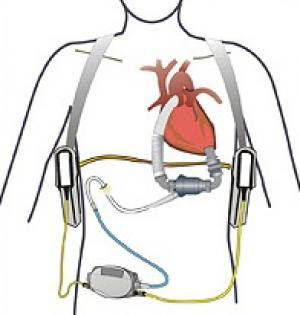

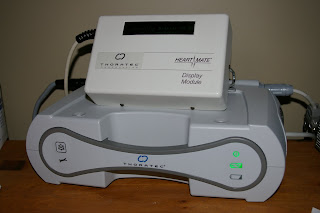
The percutaneous lead, also known as the drive line, is connect at one end to the LVAD inside of me, exits my skin and connects to the controller. The controller is the brain of the pump, if you will. It records my numbers, such as speed, flow, etc. and alerts me if anything occurs that I should be aware of. Such a case would be when the batteries are low, when the drive line is disconnected, when the controller is not functioning properly or the pump stops. The power source connects to the controller. I can have three different sources of power. One, batteries; two, the Power Base Unit (PBU); and three, the back-up battery. The batteries are mobil so I am on them all day. They actually last the whole day for me, about 15 hours. I'm connected to the the PBU at night because the alarms are much louder and would wake me up if something was to go wrong. It is plugged into the wall and has a monitor with my numbers. The back-up battery is an additional power source in case of an emergency. This could occur if the power went out, I didn't have any charged batteries AND I couldn't drive anywhere to get power from a generator elsewhere. I would like to think this would never happen but I have it just in case.

How do I carry everything, you ask?
Well, I have bags from practical to stylish! My most popular, and by far most practical, is my MEC backpack. It's actually a water pack for athletes so it's very sleek and light. I can be hands free and I often forget I have it on. It has nice support, which is a benefit because I where it just about all the time. I can fit all of my equipment into a couple of stylish purses, as well. You would never know that I'm supported by such an important, life-saving device. Some people choose to wear the holsters and others choose to wear a fanny pack. It is a personal decision.

       
Since anything could potentially go wrong at any time, I am required to carry my spare parts at all times. I have a few means of doing this as well. When Shaun was with me for the first few months he would carry my parts in his back pack. It made me feel better because I wasn't the only one. Now, since I am getting out without him I have a small suitcase on wheels. In this bag I must carry spare batteries, a spare controller, a spare clip, a spare alarm battery, dressing materials (in case I spill on the drive line exit site) and emergency contact numbers. If I want to get out for a walk I use my school backpack and put my connected parts as well as my spare parts in the one bag. This makes for additional exercise!

My doctor was kind enough to send me a copy of my xray. I found it incredibly interesting so I thought I would share it. There is a cloudy part that everything is connected to, that's my heart. You can see the details of the LVAD, my ICD (Ivan) and the wires along my sternum. There is ALOT going on in there. Metal detectors would scream at me!


There are some limitations I must remember while supported by the LVAD. I must avoid any significant static shock, ie. vacuuming rugs, touching tv screens.  I cannot swim or be immersed in any water. I have a shower bag that is particularly designed for the LVAD. I cannot jump since the LVAD could disconnect from my heart. I cannot be in a car seat that has airbags. If they were to fire it could also disconnect the pump. I cannot have an MRI, which was also considered when I had Ivan implanted. The settings of Ivan cannot be changed because it interferes with the LVAD. I cannot sleep or lie on my stomach because of the drive line exit site. It seems like a lot but really I just get used to not doing particular things and forget about it.

What does it feel like inside you?

Another good question. At first, it hurt like words I cannot type here. I am smaller than the average patient and the LVAD barely fit in. For a good three months or so I was in constant pain. It would rub against my ribs and I would feel it's weight shift whenever I moved. Other pain would be associated with having open-heart surgery. For a while now, I have been off all pain killers and I really don't feel any pain. I honestly forget about the device and just go on living. That's the goal, right? I am very sensitive to anybody going near my abdomin, though. As you can see from the xray, there is reason to protect it.

I feel the humming if I put my hand over the LVAD and I can hear the humming when I don't have a shirt on. I often don't notice. I think I'm merely desensitized to the device. It's just the way it is.

How do you handle it emotionally?

To keep it simple, I really try not to think about the difficult things and take advantage of living. I feel great and I want to enjoy it. I am battery-powered. And I am proud to be given a second chance at living. I want to make the most out of this opportunity. If I go tomorrow, I don't want to be remembered for the things I complain about, I want to be remembered for the difference I made.

It does suck, don't get me wrong. But there is nothing I can do to the change it. I only have the power to change what's next. And so I embrace all that I can, tell those close to me that I love them, and just keep going. What would you do?

Thursday, May 28, 2009

About Andrea

Well I have experienced quite a journey to stay true to my heart. It's been a long road but I feel I have found the right direction and along with it, where I can make a mark on this world.

It all began in May of 2008 when I was diagnosed with idiopathic dilated cardiomyopathy. At first I didn't understand the severity of this disease and expected that I would take meds, get better and continue on the path we had planned. Through an experience of heart failure and the implantation of an ICD, Implantable Cardioverter Defibrillator, we began to understand that things will need to change.

I had been with Shaun for about 4 years prior to diagnosis. We bought a house together, adopted some pets, and discussed our future. Three weeks after I was diagnosed with heart disease, he proposed to me. The future in general became unclear, but we knew one thing for sure, however long we had, we wanted to spend that time together. He is my rock, my knight in shining armour. He has made this disease easier to cope with and given me something to fight for. At the time, I didn't understand what that really meant and how true it would become.

So I was told that I would just have to live with 20% left-sided heart function. I was not severe enough to be added to the transplant list, although I was being followed be an out-patient clinic. I had my ICD, affectionately named Ivan, and that was the most important thing to prevent against sudden death, a blunt comfort.

When 2009 began I planned my wedding. I planned it all. It was so much fun. I wasn't in a condition to work, as of yet, so I made this my job. I made my flowers, the cake, the favours, the invitations, the thank-you cards, and organized everything. We married in May of 2009 and the day was absolutely beautiful. I married the man of my dreams. Committed my life to him in front of all my dearest family and friends. As the night passed on, we had dinner and began our speeches. Shaun and I decided to do our speech first so we could relax for the others. Well Ivan was not happy with the speech and decided to make his presence known. Two minutes into the speech he fired three times. My new husband caught me before I fell to the floor. I was taken to St. Mary's Hopsital in Kitchener, not knowing that this hospital would later save my life.

The nurses and staff planned a little party for us and our family in the hospital that night. We were able to cut the cake, throw the bouquet and have a toast. They treated me wonderfully and made the difficult experience a little better.

The summer of 2009 brought some strange symptoms. Through about 3 months of abdominal pain and difficulty eating it was determined that I was in SEVERE heart failure. It was a nurse at St. Mary's that got me to see a doctor. My existing cardiologist continuously told me it was a gastrointestinal issue, as did ER doctors and surgeons. None-the-less, I got to the right people. They treated me and determined my condition was more severe than their facility could handle and they sent me to Toronto General Hospital to be evaluated for transplant.

I was then approved on the transplant list and experienced the fight of my life. Hooked up to about 15 IV's did nothing to improve my condition. I waited three days for a heart to become available but I was not able to wait another day. The doctors implanted the LVAD, a Left Ventricular Assist Device to pump blood through my body since my heart was not able to do it alone. This was life saving surgery and I feel it is my second chance at life. It's purpose is a "bridge to transplant". I am still waiting for a heart transplant.

I would like to make a change in this world. I will share my experiences to promote organ and tissue donation and blood donation. Everyone wants to know what they can do to help, make a change, inform yourself and become an organ and tissue donor.